Kolb, the Alsatian worker
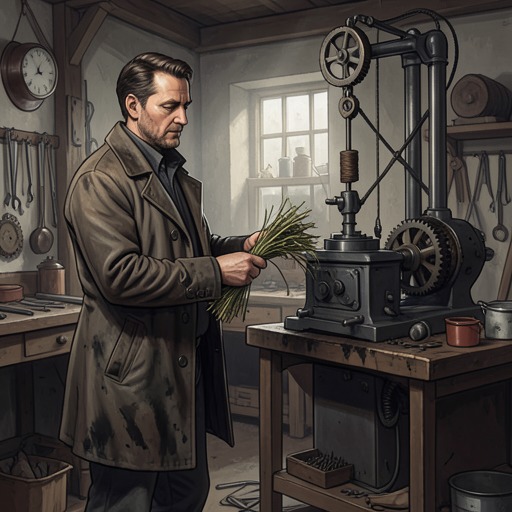
Illusions perduesKolb, the Alsatian worker, is both a resourceful hand in the Séchard printing shop and a steadfast protector of the family. His work carries Ève Séchard’s small printing venture into the surrounding countryside; when the family’s difficulties sharpen into a threat against David Séchard, Kolb offers his savings, guards his confidence, and devises the mounted escape that defeats the watchers. His importance rests less on authority than on practical skill made dependable by loyalty.
Identity and Work in the Printing Shop
The narrative identifies Kolb as an Alsatian worker and, in the escape episode, as an experienced horseman. It gives no extended personal history, but his abilities emerge through what he does: he can carry printed goods to market, organize himself under pressure, and turn familiarity with horses into a means of evading pursuit.
When Ève takes charge of the printing shop, she finds an enterprise constrained by the Cointet brothers’ control of much of its work. She has the workshop’s remaining materials inventoried and put in order, with Kolb, Marion, and Cérizet helping to clean and arrange the premises. The activity is practical and collective: Ève must find work that can use what the family still has, rather than rely on the shop’s former commercial position.
Her first venture is a run of illustrated popular legends printed on leftover paper. Kolb becomes their traveling seller, carrying the sheets to villages and selling them across a radius of twelve leagues around Angoulême. In two months, the household sells three thousand sheets. They cost thirty francs to produce and bring in three hundred francs at two sous apiece. Kolb’s work is essential to turning the press’s output into cash: printing alone would not have put the sheets into cottages and taverns.
That success has a limit. Once the local market is covered, Kolb cannot travel beyond the department, so the family has to seek another product and a broader plan. Ève turns to the Shepherds’ Almanac, a small, image-based publication intended for people who cannot read. The proposed first run is fifty thousand copies, with an anticipated profit of two thousand francs. The account distinguishes this new undertaking from Kolb’s earlier rounds as a peddler: it records his importance in selling the legends, but does not specify that he carries out the Almanac’s distribution.
Solidarity with David and Ève
Kolb’s attachment to the household becomes especially clear when David and Ève are distressed by their circumstances. He and Marion tell Ève that together they have eleven hundred francs in savings and offer the money to her, believing it could not be better placed than in her hands. The sum is presented as a shared reserve, not Kolb’s alone; its significance lies in the workers’ willingness to put what they have accumulated at the family’s disposal.
David directs Kolb to take a thousand francs to the lawyer, obtain a receipt, and keep the remainder. He also gives him a more difficult responsibility: to reveal nothing about David’s movements, hours of absence, or whatever he may bring back. David warns that people may try to buy Kolb’s silence, even with very large sums. Kolb assures him that no offer of money would make him betray the confidence. The exchange establishes that David trusts him not merely to perform a task but to protect information on which the family’s security depends.
Kolb’s loyalty is not presented as a vague declaration detached from action. When David is in danger of being caught, Kolb puts that pledge into practice. He understands that surveillance around the lawyers’ offices makes an ordinary departure risky, and he begins looking for another way out rather than sending David directly into the watchers’ path.
The Escape from Surveillance
Kolb first leaves the office quietly. He tells the servant that the lawyer is occupied for a long time and that he will return early the next morning, giving himself an unremarkable reason to go. He then runs to a horse-rental stable, selects a horse, has it saddled, and hurries back to the household, where Ève is in deep distress. The episode shows his response in stages: a plausible excuse, swift preparation, and a return with a concrete plan.
His proposal uses both movement and misdirection. He will ride away with David and draw the watchers after them; meanwhile, Ève can go to Basine Clerget, where she will not be under the same immediate scrutiny. The arrangement separates the family members for safety rather than risking a group departure that could expose them all. Ève and David part knowing that their separation may last as long as David’s voluntary concealment, and she says they will correspond through the post using Basine’s name.
As they leave, David and Kolb hear the spies’ whistles. They lead the pursuers toward the horse-rental premises near the lower end of the gate, then Kolb takes David up behind him on the horse and urges him to hold tight. Once clear, Kolb rides hard into the countryside. The watchers cannot follow them or discover where they are going. The escape is not secured by secrecy alone: Kolb deliberately draws attention in one direction, then relies on speed and horsemanship to break the pursuit.
Character and Narrative Significance
Kolb’s episodes connect the printing shop’s ordinary labor to the family’s moments of acute danger. As peddler, he helps make Ève’s first improvised business profitable; as a trusted member of the household, he and Marion offer their savings; as a horseman, he gives David a way out when close observation makes ordinary movement perilous. Each function depends on practical action, and each action has a distinct consequence for the Séchards.
The contrast between the two ventures clarifies the limits as well as the value of his work. Kolb can bring the legends to a substantial local market, but he cannot carry that trade beyond the department. His abilities do not solve the family’s larger financial and legal difficulties. They do, however, repeatedly convert immediate need into something manageable: sales from leftover paper, money placed in trusted hands, and an escape made possible by quick planning. The novel thus makes his loyalty tangible—not through a position of power, but through the work, resources, discretion, and courage he is willing to give the family.